
Lithium-ion batteries, CRISPR, AlphaFold protein folding, the list goes on. These transformational technologies that you might’ve heard of have all been awarded the Nobel Prize in the past. The Nobel Prize has long been regarded as the epitome of glory for scientists across the globe. Not only does it recognize extraordinary scientific and humanitarian achievements, but it also brings these accomplishments to public attention, inspiring confidence in human progress.
This year, the Chemistry Nobel Prize has been awarded to Henri B. Kagan and Kenso Soai for their discovery of non-linear effects and autocatalysis in asymmetric organic synthesis. This may seem overwhelming, but if you searched for 2026 Chemistry Nobel Prize predictions on the internet, almost nobody anticipated this discovery to be awarded the Nobel Prize. So what makes this discovery special?
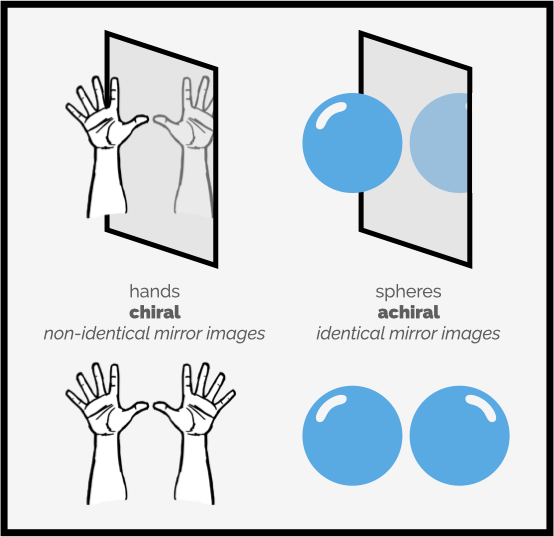
Look at your two hands. You might have noticed that they are mirror images of each other. Now, try to stack them on top of each other facing the same way. You physically cannot align them perfectly because your thumb on one hand ends up over the pinky of the other, no matter how you turn or slide them. In chemistry, molecules whose mirror images cannot be perfectly stacked on top of each other in 3D space are called “chiral,” and your hands are a classic example. In reality, many molecules are just like your hands, and in the vast majority of cases, two mirror-image molecules have the exact same chemical properties (produces a 50/50 mixture of both mirror-image forms). However, those who study biology might know that life on Earth relies exclusively on specific chiral forms: our bodies use only “left-handed” amino acids and “right-handed” sugars. This is a major puzzle because standard chemical reactions naturally produce an equal mix of both versions, making it notoriously difficult to synthesize and isolate just one.
Henri B. Kagan and Kenso Soai discovered how to break this 50/50 symmetry and amplify a preference for one mirror-image over the other. First, Kagan demonstrated that even with a non-pure catalyst (a chemical that makes a reaction proceed faster), you can produce a pretty big excess of one chiral version of a molecule over another, proving that the relationship between the purity of the catalyst and the purity of the products is not linear. Then, Soai came up with the Soai reaction. In short, after the reactant goes through a slight modification, the resulting product can act as a catalyst for its own reaction, modifying more of the reactant in the same way. In essence, the product makes more of itself, thus producing a massive excess of one mirror-image form.
By finding a way to make a heavily skewed, single-handed solution, Kagan and Soai gave biochemists a blueprint to understand how some of the molecules in our body came to be one-handed too. Most biological systems ( DNA, amino acids, and sugars) rely on just one specific mirror-image form of a molecule so being able to selectively build single-handed molecules is a cornerstone of modern pharmaceutical manufacturing. Some experts also suggest that Kagan and Soai were ultimately selected as Nobel Prize winners because their theory effectively dismantled an established “truth.” It was a common consensus that you cannot make a pure product from an impure catalyst, and the spirit of challenging that and expanding it into practical applications that explain our reality is precisely the mindset that defines the Nobel Prize.







Leave a Reply