
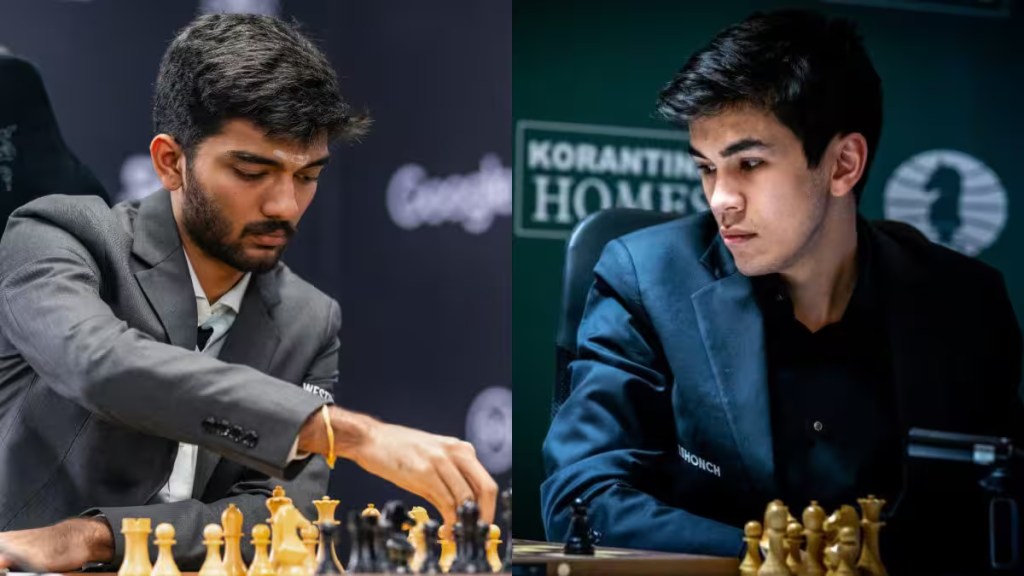
If you read the title of this article and wondered who is Gukesh? Who is Sindarov? You have come to the right place. If you didn’t know the World Chess Championship will be taking place on November 23 to December 17, 2026. However, the real question—just like in the title—is why is this a match for the ages?
Well, Gukesh Dommaraju, who is the reigning champion, is only 19 years-old. And Javokhir Sindarov is 20 years-old. This is by far the youngest field we have ever had throughout all of chess history. To put this in perspective approximately 100 years ago the competitors were in their 50s and 60s and now we have people who can’t even drink alcohol—in certain countries—who are competing.
To appreciate how surreal this 2026 matchup is, you have to rewind to the moment the chess world collectively dropped its monocle: Magnus Carlsen stepping down in 2023. The man who treated elite chess like a personal side quest simply said, “I’m bored,” and walked away. It was the “resignation heard around the world.”
His departure cracked open the door for a new generation. And by “new generation,” I mean players who were literally doing online school during the pandemic while simultaneously farming rating points on Chess.com.
When Gukesh won the 2024 Candidates—8-player round-robin to decide the World champion challenger—and then the World Championship, he didn’t just break the age record—he shattered it so thoroughly that FIDE had to double check the birth certificate. The previous youngest champion, Kasparov, was 22. Gukesh was 17. Seventeen. Most people at 17 are learning to drive; Gukesh was learning how to dethrone the entire adult population of grandmasters.
He became the reigning king not by accident, but by playing the kind of cold, clinical chess that makes engines nod approvingly.
And then came Javokhir Sindarov, who didn’t just win the 2026 Candidates—he steamrolled it. He dominated the field so thoroughly that commentators ran out of synonyms for “crushing.” His performance was reminiscent of the great Candidates runs of the past:
- Mikhail Tal in 1959, blowing everyone off the board with tactical chaos.
- Bobby Fischer in 1971, winning 6–0, 6–0, 6–0 like he was speedrunning a video game.
- Fabiano Caruana in 2018, where he played like a possessed man, who sold his soul to the devil just for some extra theory and calculation skills.

Photo of Fabiano Caruana:
Sindarov’s run belongs in that lineage. Except he did it at age 20, while half the field was still recovering from the trauma of losing to Gukesh two years earlier.
A century ago, the World Championship was contested by men who looked like they were born in sepia tone. Emmanuel Lasker, Jose Raul Capablanca, Alexander Alekhine—legends, yes, but also individuals who seemed like they’d complain about “kids these days” even when they were the kids those days.
Now? The 2026 match features two players who: grew up with engines stronger than any human in history, trained on databases larger than the Library of Congress, have never known a world where Magnus Carlsen wasn’t the GOAT. This isn’t just a generational shift. It’s a generational eviction notice.
Even though Magnus stepped down, his influence is everywhere. Every opening novelty these kids play? Magnus probably tested it in a blitz game at 3 a.m. Every endgame they convert? Magnus probably did it better in 2014. Every time someone says “the greatest ever,” they’re still talking about him.
But the throne is no longer his. And the two teenagers now fighting for it grew up idolizing him the way previous generations idolized Garry Kasparov.
This match is the first true test of the post‑Magnus era—the moment we find out what chess looks like when the adults have officially left the room.
Because it’s the first World Championship where: both players are younger than the average chess set, the defending champion is barely old enough to rent a car, and the challenger just had the most dominant Candidates run since Fischer (1971).
The so-called Magnus era is over, and the new era is being written by people who were toddlers when the iPhone came out. This isn’t just a match for the ages. It’s the match that proves the future arrived early—and it brought two teenagers with 2800‑level prep and zero respect for historical timelines.







You must be logged in to post a comment.