
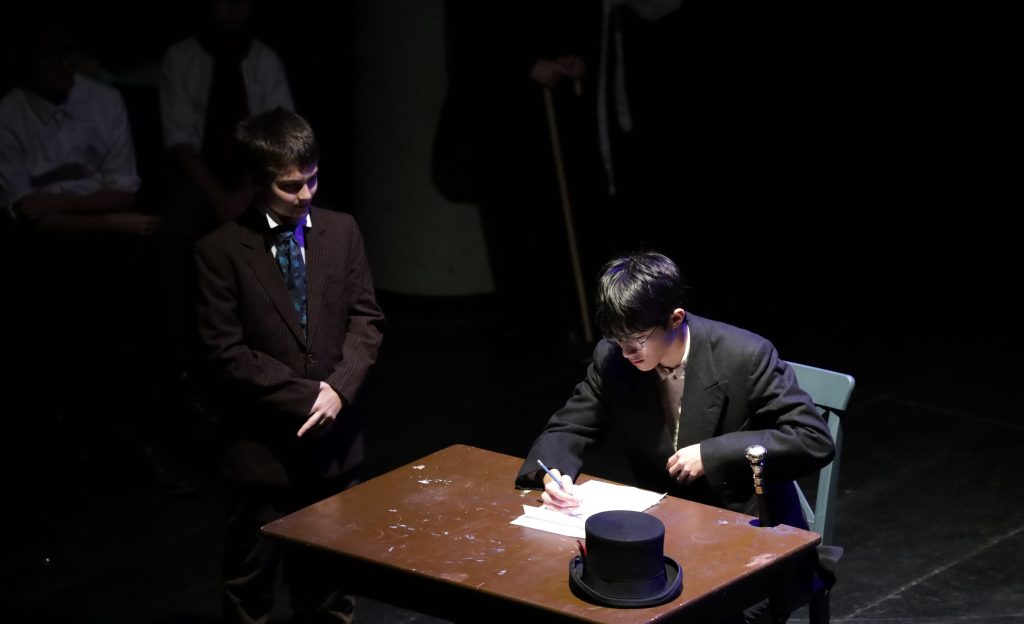
On December 4th, 5th, and 6th, at the height of the school community’s winter spirits, “A Christmas Carol,” this year’s senior play, took place in the David Chu Theatre. For those who remember last year’s senior play, you may recall the eternal suffering of sinners in Dante’s “Inferno.” Had Mr. Bauld and Ms. Blagona, our directors and concept-makers, finally had a change of heart for something more lighthearted? Perhaps “hell” as a setting was too traumatizing for the excited parents who brought their little ones along to support our theater program? After all, suffering, according to Ms. Blagona (I hope I am not misquoting my drama teacher here), makes for great theater.
The reason was no more special than the natural vacillation of our theater season, although this cheerful story may not be all rainbows and sunshine either. Published in December 1843, Charles Dickens’ original A Christmas Carol was an immediate sensation. Written under financial pressure and to raise awareness about the plight of the poor in Victorian London, the story’s themes of social responsibility, charity, and redemption still ring true today through the timeless holiday that is Christmas. Many of us understand the cultural impact of the story; it has been adapted into a massive array of media, from a musical to a Muppets film to a Justin Trudeau parody by This Hour Has 22 Minutes. The intent of UCC’s production, according to Mr. Bauld, was to highlight the darker elements of Dickens’ story. Before the ghostly visits, Scrooge’s character was not only stingy and cold-hearted but also severely misanthropic. Let us not forget his exploitative treatment of his clerk Bob Cratchit or his dehumanizing comments towards the poor and destitute just because some spectral teachings instilled generosity within his heart; whilst he did empathize with the people’s suffering shown by the Ghost of Christmas Present, he practically had morality scared into him by the foreboding Ghost of Christmas Future. Dickens did intend for his story to be a heartwarming tale, but he did not shy away from using that happiness as a vehicle for serious social commentary, criticizing the indifference of the wealthy, a timeless observation that still stands true today.
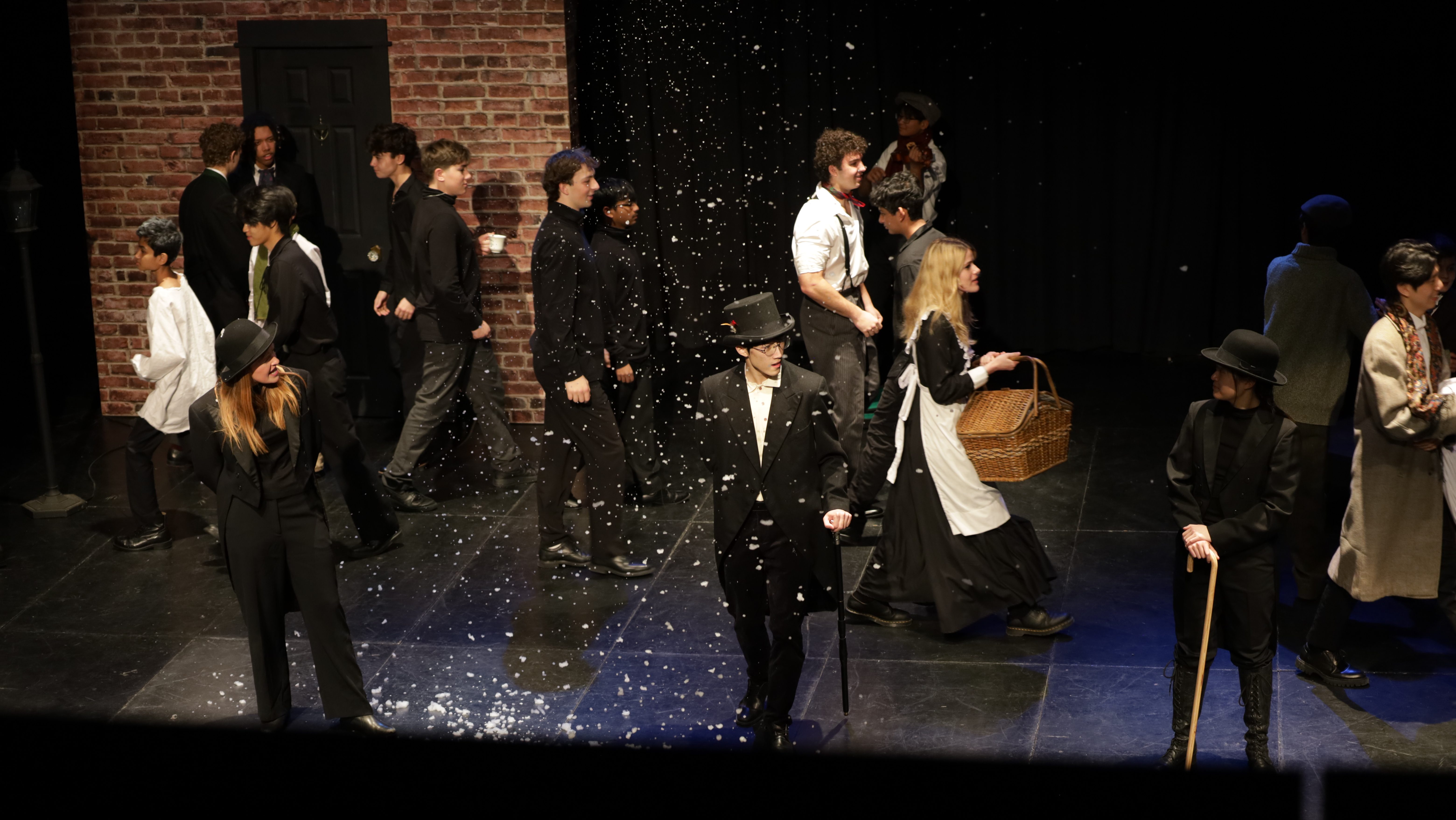
In order to evoke the darkness of the story and present it in a striking way for the audience, the directing team used a variety of stagecraft techniques. Besides the usual lighting and sound cues, some effects were specially designed and set up for the production. A few lights were trimmed in the catwalk to display the shape of a cross squarely onto the stage, which, when fully lit during the scene of Scrooge kneeling in front of his grave, elicits the gravity of his mortality and portrays his punishment through a lens of divinity. Another aspect of the staging was a projector screen, which displayed certain era-specific backdrops, as well as footage on the suffering of the destitute, reprimanding Scrooge morally as to the dangers of apathy. A light-hearted moment towards the conclusion, in the crowded streets of Christmas Day, was highlighted through the use of our very own snow machine, dispensing particles of joy onto the subterranean stage of the David Chu. Thank you to the directorial team and the talented crew who had to work long hours behind the scenes to set up such brilliant spectacles; good stagecraft always adds to the immersion of a piece.
For those who came to see the performance, we hope you enjoyed your experience. Each year’s senior play may vary in tone, but they all aim to explore parts of our humanity and help us better understand the reality of the world. We treasure theater because of its ephemerality, but we also look back with joy to the great memories the cast and crew made together, the flourishes we added to a timeless story, and the impact we were able to make on the community through our art.
Finally, to quote Tiny Tim, “God bless us, everyone!”



 The Blue and White
You must be logged in to post a comment.