

On April 1, 2025, the 2024 Jasper wildfire was finally declared as extinguished by Parks Canada, marking an end to the nine-month-long struggle against Jasper National Park’s largest wildfire in more than a century. Thanks to the selfless first responders who protected the jewel of Alberta’s Rocky Mountains, the town’s spirit remained resilient in the face of adversity. Among those who fought for the national park, most were professional wildland firefighters, Royal Canadian Mounted Police (RCMP), and municipal staff. However, volunteers and civilians, primarily under the Jasper Volunteer Fire Brigade (JVFB), also played an essential role in the town of Jasper’s structural protection, search and rescue, and supply distribution. As a result, more than 70% of the town’s structure remained standing, while most of the park’s attractions were undamaged by the wildfire. Undoubtedly, this outcome is a reflection of Canadians’ strength, courage, and preparedness, preventing the occurrence of any mass casualty.
Given the success in fully extinguishing the wildfire, Parks Canada reflected upon this catastrophic event. Parks Canada, experts, professors, and journalists commonly regarded climate change as the most significant factor of this disaster, severely intensifying the wildfire with prolonged dry periods, abnormally high temperatures, and strong winds. Indeed, on July 21, 2024, a day before the start of the wildfire, the temperature reached 38℃- more than 10℃ higher than the average temperature and not much lower than the highest ever recorded temperature of 41.2℃ in Jasper. In this case, many other factors, such as pine beetles that kill mature pine trees and make them highly flammable, are directly caused by climate change. When it comes to invasive species like pine beetles, warmer winters boost the survival rate of larvae while hot summers lead to drought-stressed trees (in which stressed trees produce less resin to defend against mass beetle attacks). Instead of Parks Canada’s solution of building fire resiliency in critical infrastructures, which can only passively prevent short-term consequences, raising awareness to climate change’s impact on the national park is what solves the root cause.
In addition to climate change, misleading policies, especially those regarding fire suppression practices, greatly boosted the intensity of disastrous wildfires. Historically, valley bottoms of the national park are naturally characterized by relatively often but minor burnings. Due to overprotective policies, most of these small-scale fires are quickly extinguished once they occur. As a result, fuels, small trees, dead wood, and shrubs are unable to be reduced through reasonable means, thus disturbing the natural cycle. Research on fire suppression policies show that when natural burnings are repeatedly extinguished and fine fuels continuously accumulate, future wildfires’ intensities will be further enhanced. This is especially concerning in areas such as Jasper National Park, in which climate change already plays a major role in promoting wildfires. To conclude, the method of repeated extinguishments does not solve the problem itself, but only postpones the problem until a greater outburst occurs. In contrast, less overprotective methods such as allowing prescribed burns are more beneficial in the long run, finding a balance between human safety and the natural cycle.
Drawn by this concerning and complicated issue, I decided to travel to Jasper as a photographer, capturing touching moments of destruction and rebirth with my lens. While it is clearly understood that this issue involves many stakeholders, and requires all Canadians to work together to solve, I genuinely hope that my photos will evoke a voice from deep inside, raising awareness to this problem.
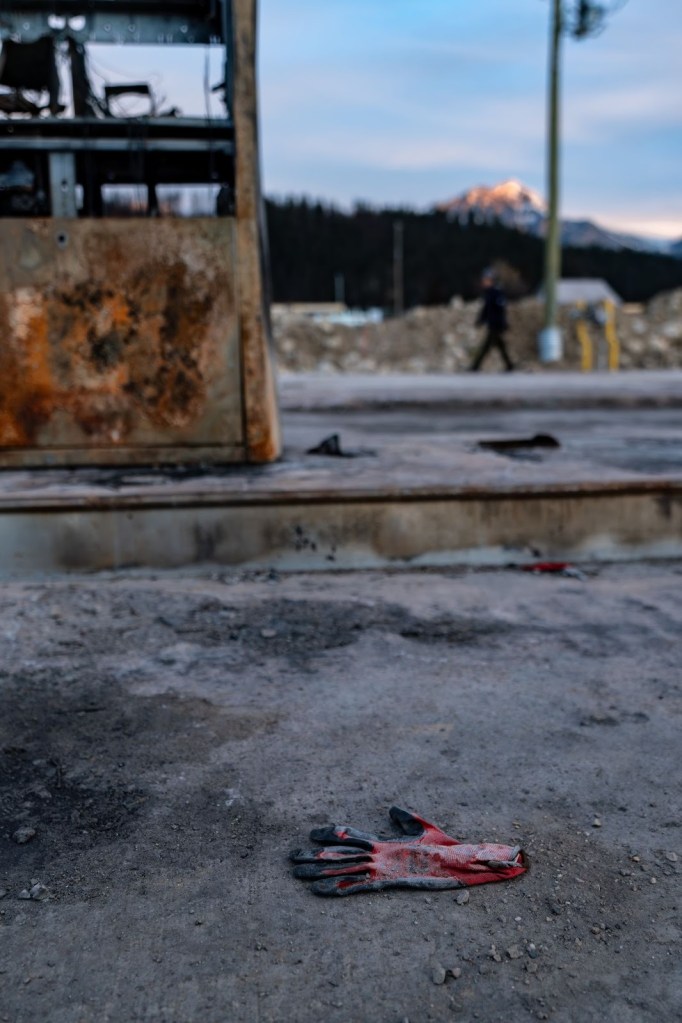
A Final Refuel in Jasper
In the silent aftermath of the Jasper wildfire, a lone rubber glove lay discarded near the charred skeleton of a gas station. Behind the scene of destruction and loss, the eternal snow of Jasper’s peaks stood as an unwavering witness.
This image is a quiet elegy. The glove, once a tool of human labor and persistence, now echoes our absence. The station, a place built for refueling journeys, will never offer refuge again.
It’s a warning written in ash: if we continue to ignore the disease of our planet, the earth, our ultimate source of sustenance, will become just like this ravaged station- empty and irreparable.
This was nature’s final refill. Let it not be ours.
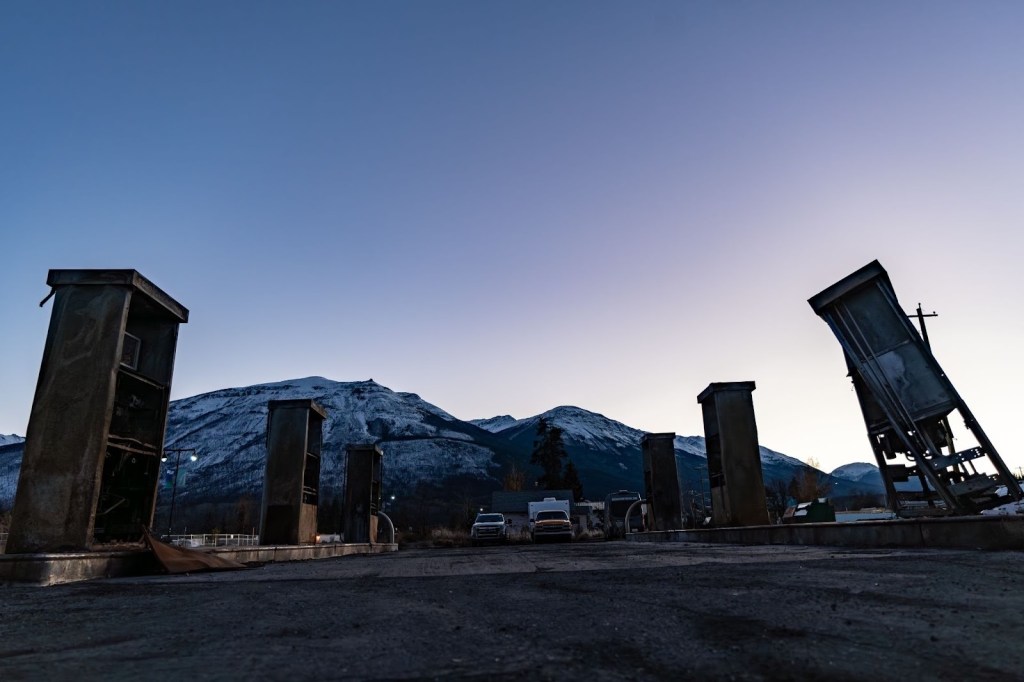
A Final Refuel in Jasper (II)
As dusk descended upon Jasper, charred gas stations stood face to face, twisted and silent like fallen sentinels frozen in a final salute. Against the cold embrace of the Rocky Mountains, they formed a haunting aisle of ruin.
Symbols that once represented journey and replenishment now stand as tragic monuments, endlessly warning us of human fragility and the warming world.
Let this scar upon the land remind us: if we continue to ignore the fragile balance of our planet, the earth, our greatest refill, will become just another requiem whispered by the wind.
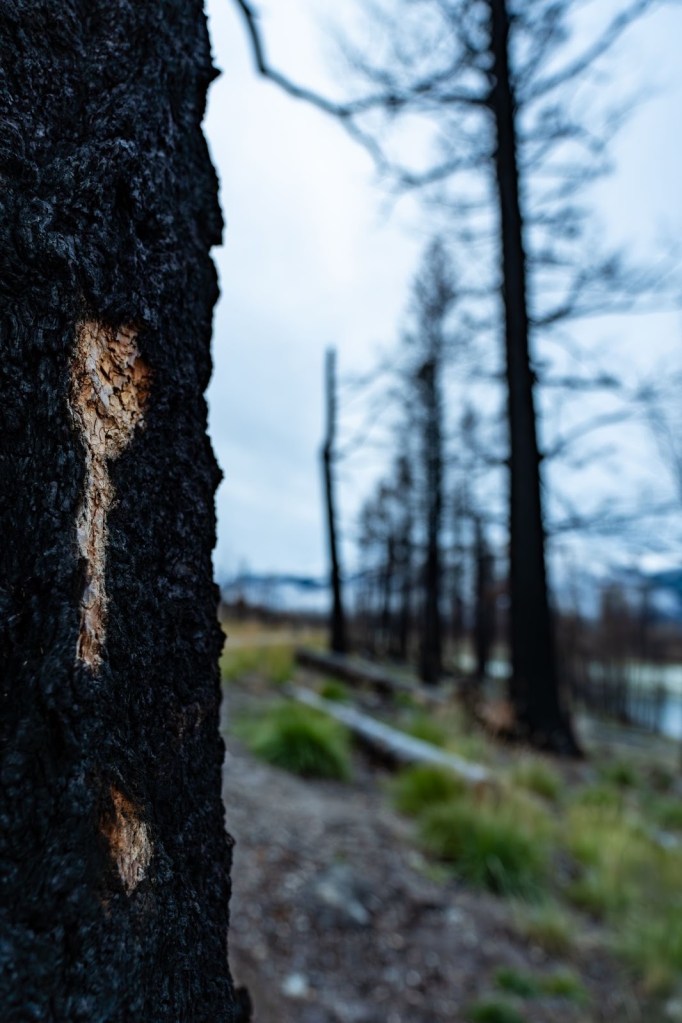
Silent Scream
A single tree, scarred by the Jasper wildfire, stood in the foreground. Its bark, torn by its falling neighbors in the chaos, has split into the stark shape of an exclamation mark.
Through this wounded resident of nature, the view stretched across a forest of darkened trunks, extending towards the distant, silent mountains and a river that still runs clear.
This mark in the shape of a plea is nature’s silent scream, a desperate punctuation in a story we’ve ignored for too long.
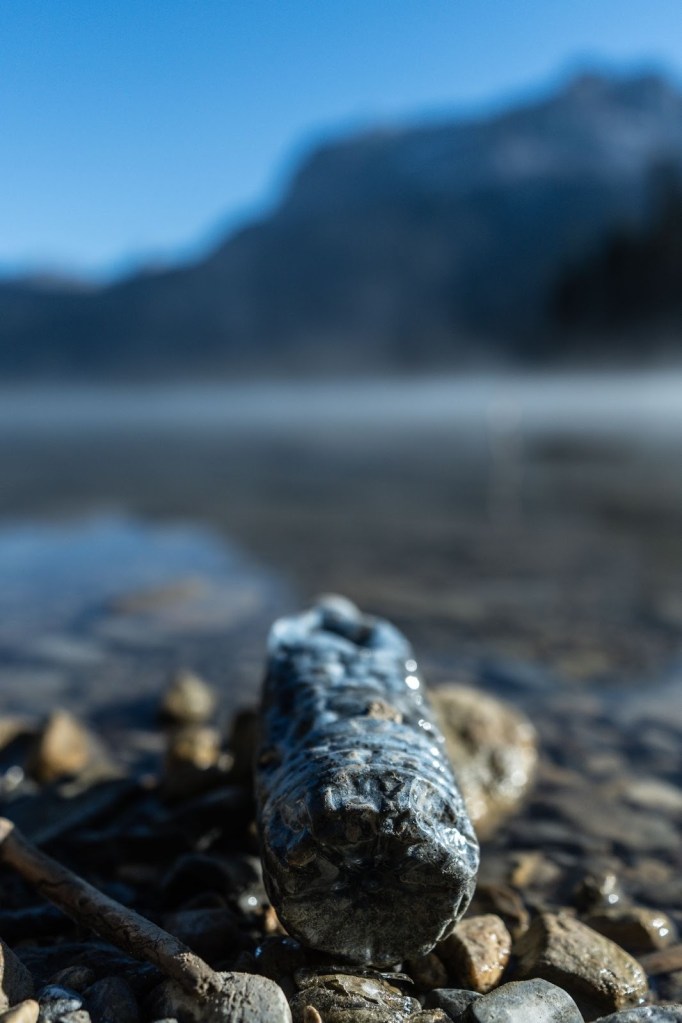
Our Signature
In the heart of Banff, a discarded plastic bottle lay undisturbed in the serene blur of mountains and lakes, a stark interruption in nature’s quiet dialogue. Centered and sharp, it rested where it never should, while the majestic Rockies withdrew softly into haze.
This is the signature we left behind: not one of reverence, but of neglect. The cold tonal palette of the scene serves as a sobering mirror to our conscience.

An Elegy in Ash
Along the riverbank of Jasper, a silenced forest stood. Charred trunks rose from ashes like monuments to a lost spring. The mountains were beyond watch, veiled in haze, while the water flowed past these new ruins.
In this wounded landscape, a subtle path was traced by a local resident walking her dog-a quiet testament to the persistence of life amid destruction. Yet, the true subject remained the forest itself: a tapestry of memory burned into nullity, where every scorched branch whispers the retelling of what it once was.
This is the elegy authored by fire- a mourning for landscapes that were lost in human misbehaviors and a quiet warning of what may still be lost.

The Scorched Root
In the aftermath of Jasper’s wildfires, a century-old giant lay uprooted, its charred roots clawing at the cold sky like a final, desperate gesture. Stones and earth clung to the massive root, torn violently from the ground that sustained it for generations.
This fallen guardian speaks of a profound violence: decades of growth erased in a single blaze. The dark, twisted root reached upward as a haunting silhouette, a silent scream against the rising temperatures and our collective indifference.
May this fallen warrior not only stir sorrow within us, but also motivate whatever action we can still do.

Dawn After Fire
Through the skeletal remains of a structure after wildfire, a scorched dawn gently unfolds. Against a sky washed in soft pink, the workers moved with purpose. Heavy machinery hummed in the distance, a determined march to renewal.
Inside, the charred frame was a threshold between memory and reality. The darkness of the ruin gave way to the growing light, where snow-capped peaks stood serene, witnessing the slow, stubborn rhythm of recovery.
This is the dawn that follows darkness, not only honoring the loss, but also gradually eradicating it.
The wildfire may be over, but the crisis is far from it. Not only are the root causes of the disaster unsolved, about 25,000 residents and visitors were evacuated with thousands of them displaced. Let us not only support workers who are repairing the ruins, but also lend a warm hand to residents who are homeless due to the wildfire. If you would like, you can donate to Jasper Community Team Society (https://www.jaspercommunityteamsociety.ca/) or the Municipality of Jasper (https://jasper-alberta.ca/p/donate) to provide a supportive voice of your own to those who are in need.






 The Blue and White
You must be logged in to post a comment.