
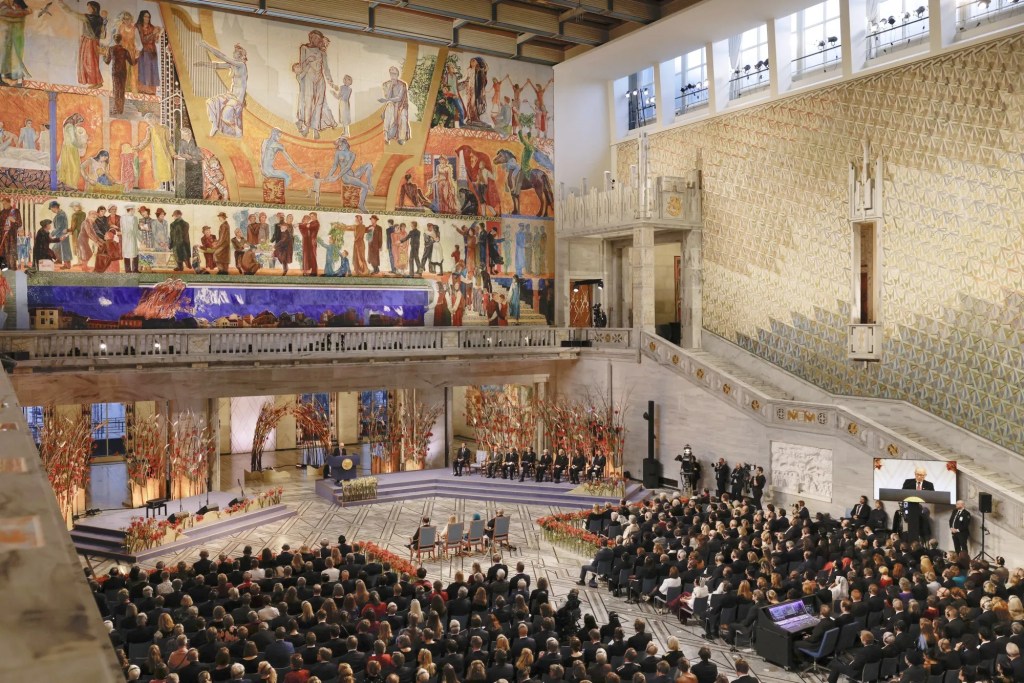

On October 13th, 2025, the final Nobel Prize winners were announced. Created by Alfred Nobel and first awarded in 1901, they recognize individuals who have brought “the greatest benefit to mankind”. This year’s winners are especially notable, since they each had to cross a difficult threshold to realize these accomplishments.
The Nobel Prize in Physics was awarded to John Clarke, Michel Devoret, and John Martinis, for their discovery of “macroscopic quantum mechanical tunnelling and energy quantisation in an electric circuit.” They conducted an experiment on a circuit that marked the first time quantum mechanics were observed and proven at a tangible level. Before this breakthrough, it was believed that quantum mechanics only existed at the microscopic level, because interactions with the environment tended to remove quantum behaviour. They broke the barrier of intangibility, and allowed future technologies to actually use quantum engineering to solve problems.
The Nobel Prize in Chemistry was awarded to Susumu Kitagawa, Richard Robson, and Omar Yaghi, for the “development of metal-organic frameworks.” This is an entirely new form of molecular architecture, where metal ions are connected to form porous materials. These MOFs can absorb and store gases and liquids, which enable technologies to capture CO2, harvest water from the air, or even store dangerous gases like hydrogen. More importantly, the fluids it can capture depend on the metal used in its formation, which allows it to specialize to many different tasks. This invention unlocked the power of negative space: a material could both be a support and a storage block.
The Nobel Prize in Medicine was awarded to Mary Brunkow, Fred Ramsdell, and Shimon Sakaguchi, for their “discoveries concerning peripheral immune tolerance”. They found out how our immune system controls itself, and how autoimmune diseases are formed, which allows us to provide better medical treatment for patients. In addition, it also unlocked new treatment pathways for diseases like cancer, contributing to a healthier world. This progress revealed the difficult balancing act our immune system performs to stay on the threshold between overaggression towards cells and diseases, and complacency.
The Nobel Prize in Literature was awarded to László Krasznahorkai for his “compelling and visionary oeuvre that, in the midst of apocalyptic terror, reaffirms the power of art.” His unique writing style, combining absurdism with elegant and complex sentences, creates an immersive reading experience. He delves into dystopian and apocalyptic ideas, which shows the evolution from classical literature to modern literature.
The Nobel Peace Prize was awarded to Maria Corina Machado for “her tireless work promoting democratic rights for the people of Venezuela and for her struggle to achieve a just and peaceful transition from dictatorship to democracy.” She never backed down, even crossing the threshold of safety to stay true to her morals and continue campaigning for democracy. She was even briefly unjustly jailed in January, which is a testament to her bravery and courage.
Finally, the Nobel Prize in Economics was awarded to Joel Mokyr, Philippe Aghion, and Peter Howitt. They “identified the prerequisites for sustained growth through technological progress,” and formed the “theory of sustained growth through creative destruction.” We are currently living in a rare period of continual economic growth, which has increased the quality of life globally. This economic model presents how and why our economy has been growing, which allows us to keep this trend going in the future, potentially making this anomaly into normality.
Overall, they have all contributed tremendously to society. In a few short weeks, on December 10, 2025, their names will be forever etched into the history books during the official Nobel Prize ceremony.




 The Blue and White
You must be logged in to post a comment.