

Automatic Speed Enforcement (ASE), or speed cameras have become an ever noticeable part of urban life in the province. According to the provincial government, over 700 speed cameras have been installed in 40 municipalities since May 2019, with 150 in the City of Toronto alone. These systems have gained notoriety due to their unforgiving and brutally effective nature, handing out approximately 560,000 tickets in 2024. On September 9th, 2025, the city woke up to 16 cameras either cut down or destroyed. For months, Premier Ford had publicly railed against these systems, calling them a “cash grab” and saying that “Instead of making life more expensive by sending speeding tickets to drivers weeks after the fact”, the government should “support road-safety measures that will prevent speeding in the first place.” That morning, the spokesperson for the provincial Transportation Minister said in an email that “We [the government] are prepared to help get rid of them”. Shortly after, the government announced that they would introduce legislation to ban the use of speed cameras across the province.
Ever since the Ford government announced their intentions to ban the use of speed cameras, there has been widespread backlash from municipalities, police associations, and other civil organizations. According to the municipality of London, there has been an average decrease of 5-7km/h in areas with speed cameras. A commonly cited study by proponents of ASE’s by the Hospital for Sick Children (Sick Kids) showed that there was a 45 per cent reduction of speeding in school zones with speed cameras, and that there was an 88 per cent drop in vehicles 20km/h or more above the speed limit. Ever since their inception, they have also become an important part of revenue generation for municipalities. Toronto alone generated revenues in excess of $40 million in 2024 from ASE fines. With municipal budget pressures increasing, property taxes were hiked by 16.4 per cent over the last two years. Tax hikes in general are unpopular, and voters are more willing to see increased punishment for speeders than indiscriminate property tax hikes.
Mayor Chow and other municipal leaders from across the province have insisted repeatedly that these systems are primarily about safety. While safety is no doubt an important feature of the current system, it is impossible to ignore the ever growing revenues generated. Base fines are decided by Schedule D of the Highway Traffic Act. This is a piece of provincial legislation that governs the fines set for speeding in community safety zones (the zones in which all ASE systems are located).
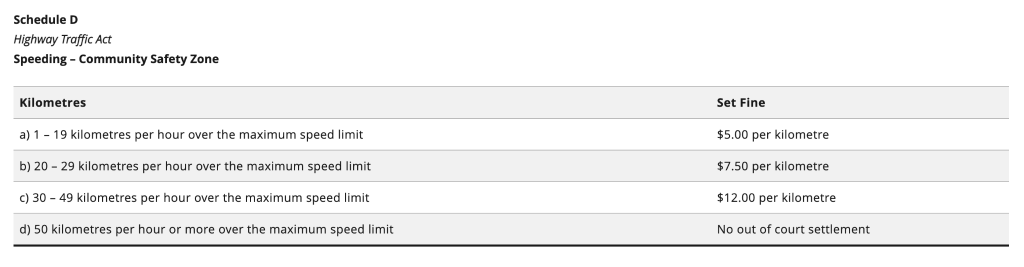
In addition to these arbitrary rates there are a whole slew of other mandatory fees associated with speeding:
- Victim Component Fee (25% surcharge on fine)
- License Plate Research Fee ($8.25)
- Additional Fees (Listed Below)

Someone travelling just 5km/h over the limit ends up paying $40.50, not including additional fees. The question we should be asking is a fine of this magnitude proportional to the damage being caused by speeding slightly over the limit? Municipalities have a conflict of interest when it comes to ensuring that these systems are fair due to the sheer scale of the revenue they can generate from them.
There is a lot the provincial government can do to help reform the system without taking away a valuable safety tool from municipalities. Unlike police officers, cameras are not able to exercise discretion when it comes to issuing tickets. They aren’t able to account for real world driving scenarios, such as overtakes or the natural flow of traffic. Schedule D of the Highway Traffic Act should be amended to include a 10km/h buffer (in relation to the speed limit). This threshold is already a widely held assumption, and although not enshrined in the law, would ensure greater fairness and proportionality in fine issuance. Secondly, the system used to calculate punishments should be completely overhauled. Instead of the current arbitrary fine rates, a system of “progressive punishment” should be introduced. This would punish offenders by fining them as a proportion of their daily income. Not only would such a system relieve the burden on people struggling to get by, but it would also ensure that no matter how wealthy a person is, the fine will be felt to the same proportion. A poll conducted in 2023 found that 63 per cent of Ontarians were supportive of implementing such a system, providing a clear mandate for any provincial government to act. These two changes would help restore public faith in ASE’s, while ensuring they are not compromised as a public safety tool.






 The Blue and White
You must be logged in to post a comment.