
By Jacob Ossip
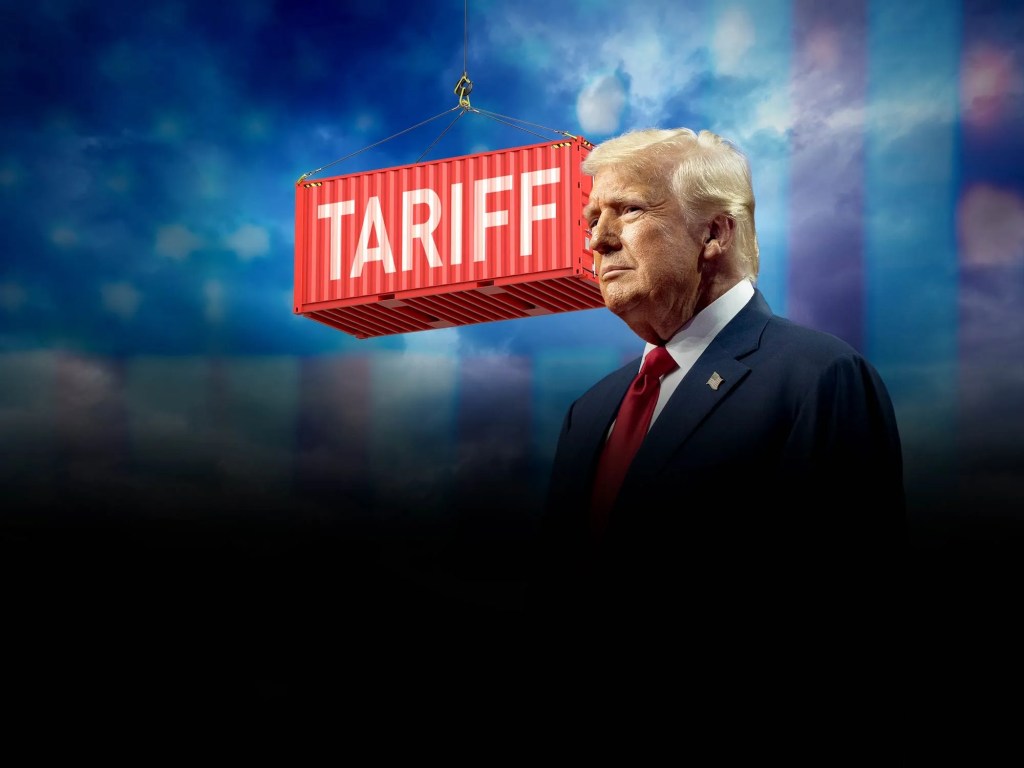
Following his inauguration, Trump foreshadowed heavy tariffs on China, Canada, and Mexico. He followed through on February 1st, signing executive orders imposing 25% tariffs on Canada and Mexico, with a reduced 10% tariff for China. Fortunately, the tariffs on Canada were delayed by a month. If imposed, however, what does this mean for our country?
What is a tariff? Who does it affect?
A tariff is an additional tax imposed by the federal government on foreign imports. Imagine importing an orange from Florida. Suppose the orange costs $10 and Canada’s tariff on U.S. oranges is 25%. If you buy this orange in Florida, it costs $10. However, if you import it to Canada, you would pay the exporter $10 plus a 25% tariff ($2.50) to the Canadian government, bringing the total to $12.50.
Who does this affect? Well, essentially everyone. The exporters face reduced demand for their products, reducing sales. Since tariffs drive up the cost of imported goods, consumers ultimately face higher prices. Back to the orange example – orange farmers in Florida now sell fewer oranges to Canadians, meaning they earn less money. Since Canadian grocery stores must now purchase the oranges at a higher price, they must increase their selling price of the oranges. This will reduce their revenue while increasing prices for you, the ultimate consumer.
However, if there is a loser, there must be a winner. The only real winners of a tariff war are local producers and the federal government. The federal government simply earns additional tax revenue. The orange farmers in Florida have now lost a portion of their share in Canada’s orange market. Canadian orange farmers, though, now face increased demand due to the sudden price increase of competitors’ products. Therefore, they can increase their prices and quantity supplied in order to reach the new market equilibrium – the point at which they earn the most profits.
Why did Trump impose the tariffs? To what extent will it affect Canada?
Now that we have evaluated what a tariff is, we must consider their political and economic implications. Specifically, what are the hypotheticals surrounding the U.S.-Canada “tariff war,” and how will these hypotheticals affect U.S.-Canada interdependence?
It is important to understand why Trump is imposing such tariffs. As he claims, the tariffs help protect the American economy and population from the “major threat of illegal aliens and deadly drugs.” Is this really the case, though? Less than 1% of fentanyl smuggled into the U.S. comes from Canada, and according to data published by the U.S. Customs and Border Protection, Border Patrol agents intercepted over 21,000 migrants illegally crossing from Canada into the U.S. in the first 10 months of 2024. This is a relatively low number compared to the 53,900 Border Patrol encounters reported along the U.S. southern border in September 2024 alone. Considering Trump threatened nearly the exact same tariffs on Canada and Mexico despite the difference in the two nations’ border fortification levels, perhaps there are other motives behind the tariffs.
As examined earlier, the tariffs will support local American producers, predominantly in primary sectors such as farming and manufacturing. This will increase demand for their products and therefore require more labour. Does Trump want more jobs in primary sectors? If so, why would he?
Trump’s motives behind the tariffs cannot fully be confirmed nor identified, though after both Canada and Mexico agreed to further fortify their borders, Trump delayed the tariffs by 30 days. This suggests that Trump may be using the tariffs as leverage to advance his “America-first” realist policy on border enforcement.
This may suggest that if we, Canada, can end our “border crisis,” then the tariffs will be abolished as a whole. However, this is not guaranteed. If that is not the case, what hypotheticals may arise for Canada-U.S. relations?
Most Canadians hope for the tariffs to be abolished, meaning Canada too will drop their retaliatory tariffs, and for trade relations to be as they were pre-Trump. This will allow the Canadian economy to grow under security from the U.S. without the threat of requiring a separate global trade partner. Trump claims that the U.S. is essentially subsidizing Canada with $200 billion each year. Considering his realist ideology, he likely will not ignore this, and therefore not abolish all tariffs.
This leads to the next (somewhat) positive hypothetical: tariffs on small quantities of products. Trump has foreshadowed tariffs on steel and aluminum imports. Canada exports roughly 10 million tonnes of steel to the U.S. each year, about half of all steel produced in Canada. The industry employs roughly 23,000 Canadians, mostly in Ontario. Tariffs imposed on Canadian steel by the U.S. will harm this industry, though as a whole, will barely pose a threat to the national economy compared to tariffs on all products.
Now, imagine that at the end of the 30-day delay, the tariffs are imposed. This would be the worst immediate-case scenario. With Canada’s counter-tariffs on $155B of U.S. goods, it may be the beginning of the fallout of the Canada-U.S. economic relationship. This means finding other nations to import goods from and export them to, whether they are politically Eastern or Western. If Canada fails to do this, its economy could experience a rapid decline due to a severe deficit.
It is undeniable that Canada relies on the U.S. more than the U.S. depends on Canada. Roughly 75% of Canadian exports in 2024 went to the U.S while only 18% of American exports went to Canada. If the nations completely cut off trade, Canada is essentially screwed. Therefore, the nation will do nearly anything possible to avoid trade conflicts.
Overall, predicting how the tariff situation will unfold remains uncertain. Imagine a spectrum; on one end exists the strong U.S.-Canada economic relationship that existed before Trump, and on the other, a full-scale trade war with severe tariffs on nearly all goods. Over Trump’s four years in the White House, Canada’s position on this spectrum will likely shift. The best-case scenario is that Trump recognizes the deep economic interdependence between the two nations and adjusts his policies accordingly. Until then, Canada must navigate uncertainty, balancing economic resilience with diplomatic strategy.






 The Blue and White