

- Ray Rice Domestic Violence Case
Ray Rice, a six year veteran running back for the Baltimore Ravens, was arrested on February 15, 2014 at an Atlantic City casino. Since being drafted in the second round by the Ravens in 2008, Rice has been selected to three Pro Bowls and was a key contributor for the Ravens when they won the Super Bowl in 2013. Hours after his arrest was reported, CCTV footage was released, showing Rice dragging his then fiancée Janay Palmer from an elevator in the Revel Hotel. Atlantic City Police Department immediately stated that “after reviewing surveillance footage, it appeared both parties were involved in a physical altercation”. The NFL also reported that Rice had hit Janay Palmer and caused her to lose consciousness.
Following the incident, Rice was charged with third-degree aggravated assault and banned by the NFL for two games in the following season. However, months later on September 8, the full footage of Rice’s assault inside the Revel Hotel elevator was released by TMZ. This footage showed Rice and Palmer getting into an argument that erupted into a violent physical altercation in the elevator, before Rice punched her in the face which caused her to fall and hit her head on the elevator handrail. The end of the video shows Rice dragging an unconscious Palmer out of the elevator. The Ravens released Rice shortly after the emergence of this viral video, with an NFL spokesperson then announcing his indefinite ban from the NFL.
Although Rice filed and won his appeal of an indefinite suspension from the NFL in November of 2014, the negative reputations surrounding his name effectively ended his career as no NFL team was willing to sign him in Free Agency. To this day, Ray and Janay Rice remain happily married with two daughters, and have moved far past this decade-old incident. As an individual, he has made honourable efforts to restore his reputation in his community, like organizing anti-bullying campaigns, and using his personal experience to become an advocate against domestic violence.

- Michael Vick Dogfighting Operation
Since being drafted by the Atlanta Falcons with the number one overall pick in the 2001 NFL draft, Vick has taken the league by storm. He became one of the most exciting players to watch, due to his unprecedented scrambling ability at the quarterback position, and received three Pro Bowl honours (2002, 2004, 2005).
However, his NFL career was in jeopardy after authorities found evidence of a dog fighting ring and over seventy dogs in a span of multiple searches of his property in Surry County, Virginia. Such findings drew widespread public attention because of concerns over animal abuse as well as illegal gambling operations that were run, which were often associated with dog fighting.
In July 2007, Vick and three other men were charged on federal offense and state felony charges on allegations that included his direct involvement in dog fighting, high-stakes gambling, and brutal execution of dogs. Details were publicly released by the media of these executions which included drowning, electrocuting, hanging, and shooting dogs. By August 17, all three of Vick’s co-defendants (Taylor, Peace, and Phillips) had pleaded guilty to the charges, which left Vick no choice but to plead guilty as well, which he did on August 20 to the federal felony dog fighting conspiracy charge.
In the scheduled sentencing on December 10, Vick faced a maximum of five years in prison, a fine of $250,000 and three years of supervised release. He was sentenced to 23 months in prison, which was higher than the recommended length by the prosecutors who suggested 12-18 months if Vick had agreed to do the terms in the original plea agreement. The plea agreement included Vick cooperating with federal authorities to pursue other dog fighting cases, a complete truthful detailed account of his role in the dog fighting operations, as well as forfeiting his right to appeal any sentence imposed upon him.
Subsequently, Vick was suspended by the NFL and released by the team that drafted him, the Falcons. After being released from prison in May 2009 and placed under house arrest for two months, Vick was reinstated by the NFL prior to the 2009 season. He signed with the Philadelphia Eagles on a one year, $1.6 million contract with a team option for the 2010 season worth $5 million. Although he did not play a big role in his first season with the Eagles as the backup quarterback, he went on to win the 2010 Comeback Player of the Year and was named to his fourth Pro Bowl in his second season with the Eagles. Vick played for the Eagles for another three seasons, and before concluding his career on one year deals with the Jets and Steelers.

- Henry Ruggs III Car Crash
Henry Ruggs III was the first receiver off the board in a historical 2020 wide receiver class that featured other notable names like Ceedee Lamb, Justin Jefferson, and Brandon Aiyuk. He won the CFP National Championship with Alabama as a freshman, and had 98 receptions for 1716 yards and 24 touchdowns in his college career. In 20 games with the Raiders, Ruggs accumulated 50 receptions for 921 yards and four touchdowns. His NFL career ended abruptly when the Raiders released him the same day that he was involved in a lethal car crash.
On November 2, 2021, Ruggs and his girlfriend Kiara Kilgo-Washington, were seen drinking and leaving a Topgolf location in the Las Vegas Strip in Paradise sometime after midnight. Produced digital evidence showed that at approximately 3:39 am, while driving his Chevrolet Corvette at 156 miles per hour, Ruggs rear-ended another car in Spring Valley, outside of Las Vegas. The victim Tina Tintor and her dog died in their Toyota RAV4, which had been engulfed in flames due to the crash rupturing the vehicle’s fuel tank. Ruggs and Kilgo-Washington were transported to the University Medical Center of Southern Nevada for treatment of non-life-threatening injuries. Shortly after, Ruggs was booked into a Las Vegas jail.
The following day, Ruggs appeared in court and was set a bond of $150,000. He was then put under house arrest with strict conditions like electronic monitoring, no alcohol, no driving, and the surrender of his passport.
On May 10, 2023, as part of a plea agreement, Ruggs pleaded guilty to one count of felony DUI resulting in death and one count of misdemeanor vehicular manslaughter.
On August 9, 2023, Ruggs was sentenced to a minimum of 36 months and a maximum of 120 months, and he is eligible for parole after three years.
As of May 2024, Ruggs is serving his sentence at Stewart Concentration Camp in northern Nevada, while also working for government offices making $2.50 an hour as a “community trusty”.

- Aaron Hernandez Murder
Going into the 2013 offseason, Aaron Hernandez, a tight end for the New England Patriots, looked like one of the most promising young players in the NFL. Since entering the league in 2010, Hernandez has had three straight seasons of 5 or more touchdowns while forming one of the best tight end tandems in NFL history with Hall of Famer Rob Gronkowski. Prior to the 2012 – 13 season, Hernandez had signed a five-year, $39.58 million contract extension with the Patriots, including a signing bonus of $12.50 million, which was the largest bonus ever for a tight end. While it may have seemed like a perfect beginning for anyone’s professional football career, Hernandez’s life would flip upside down when he is identified to be involved in the murder of Odin Lloyd, the boyfriend of the sister of Hernandez’s fiancée.
On June 17, 2013, Lloyd was shot and killed in an industrial park located one mile from Hernandez’s house, where his body would later be found the same day. There was lots of evidence that tied Hernandez to the murder. According to text messages, Lloyd was reportedly riding in Hernandez’s vehicle in the morning hours of the day, and keys to a car that had been rented by Hernandez were found in Lloyd’s pocket. DNA that was found at the scene also matched Hernandez. Furthermore, crime scene investigators were able to find shoe tracks at the crime scene that made the same impression of shoes worn by Hernandez the same night according to surveillance footage.
Based on such evidence, police searched Hernandez’s house on June 18. They found that he had intentionally destroyed his home security system, and hired a team of house cleaners, which further raised suspicions.
On June 26, Hernandez was arrested at his home and charged with first-degree murder, one count of carrying a firearm without a license, two counts of possessing a large-capacity firearm, and two counts of possessing a firearm without a firearm identification card. Following his arrest, he was held without bail at the Bristol County Jail and House of Correction until his trial in 2015.
Following a nearly three month trial that began on January 29, 2015, Hernandez was convicted of first-degree murder and all weapons charges. He was subsequently sentenced to life in prison without the possibility of parole at the Souza-Baranowski Correctional Center. While serving his sentence, Hernandez was fighting two other cases involving a 2012 double homicide as well as the shooting of a friend in 2013. He was acquitted of all charges on April 14, 2017, except for one count of illegal possession of firearms. On April 19, 2017 at around 3:05 am, days after he was acquitted of these charges, Hernandez was found hanging in his prison cell. His death was later ruled a suicide. Following his death, Hernandez was diagnosed with chronic traumatic encephalopathy (CTE), a brain disorder that is caused by repeated blows to the head, and is often found in athletes playing contact sports like football. CTE has been said to cause aggression, impulsive behaviour, depression, and much more. Many people have speculated how CTE has played a major role in his behaviour, and raised awareness for football players with brain injuries.

- OJ Simpson Murder
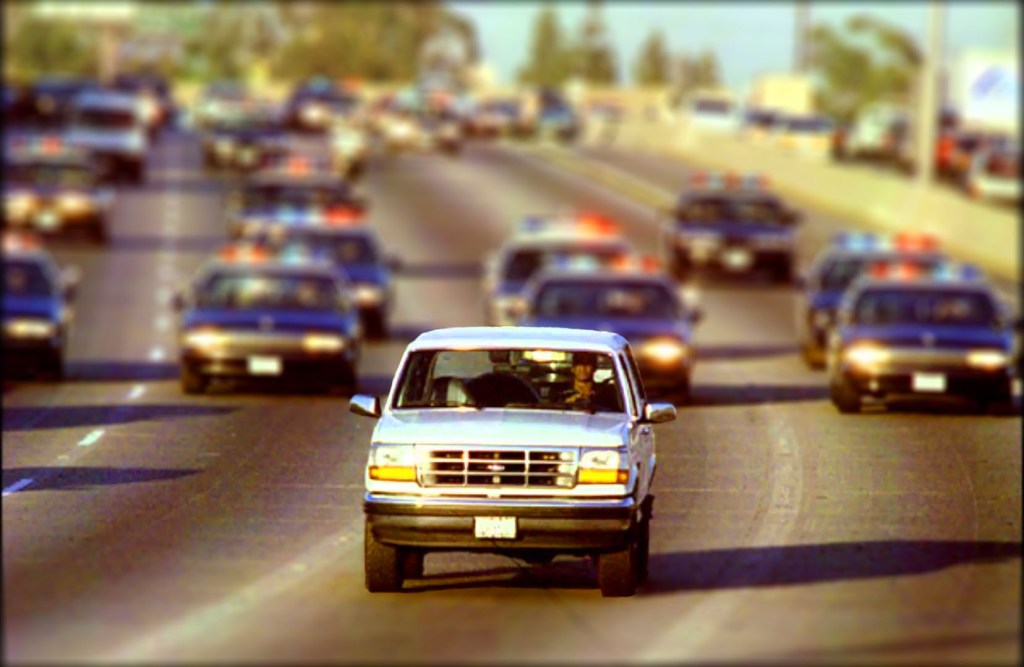
It is June 17, 1994, where the Houston Rockets and the New York Knicks are in the midst of a back and forth crucial game 5 of the 1994 NBA Finals. Suddenly, the broadcast to millions of fans across the world is interrupted. NBC had cut to footage of a white Ford Bronco driven by Al Cowlings going down the highway, with OJ Simpson in the backseat. Not far behind the car were a number of LAPD officers, who were in pursuit of the car for 60 miles up and down highways. The car chase ended when he arrived at his Brentwood estate at 8:00 pm. Simpson reportedly remained in his car for about 45 minutes, went inside for about an hour, before finally surrendering to authorities. In the car, police found “$8,000 in cash, a change of clothing, a loaded .357 Magnum, a United States passport, family pictures, and a disguise kit with a fake goatee and mustache.” The public perception was that he was attempting to flee. At the time, Simpson was the main suspect in a double murder involving his ex-wife Nicole Brown, and her friend Ronald Goldman.
But before we continue further, what is the background to the car chase?
OJ Simpson played in the NFL as a running back from 1969 – 1979 where he became the first player to ever rush for 2,000 yards in a single season. During his career with most notably the Bills and later the 49ers, he won the MVP in 1973, and was a 5 time first-team all-pro as well as pro bowler from 1972 – 1976. After his retirement in 1979, Simpson acted in film and television, became a sportscaster, and was a spokesman for a wide variety of products and companies.
On the evening of June 12, 1994, Simpson and Brown had been attending the dance recital of their daughter Sydney. Afterwards, Brown went to eat dinner with her family, while Simpson went home and ate takeout food with Kato Kaelin, his family friend who was staying at his estate. At around midnight, a neighbouring couple to Brown’s condominium had followed her dog to her home, where they found her body lying face down at the bottom of the stairs leading to the door. When police arrived, they found Goldman’s body near Brown’s. Based on the evidence, investigators largely concluded that someone had stabbed Brown to death sometime that night, then when they saw Goldman walk in to deliver a pair of glasses, they killed him as well to remove any witnesses at the scene.
On the night of June 12, Simpson had been scheduled to board a flight to Chicago, and it is concluded that he boarded the flight sometime after the murder had occurred. When detectives had arrived at Simpson’s estate to notify him of the death of his ex-wife, Simpson was not to be found, but a blood-stained right-hand glove was found on the property, which later proved to be a match to the left-hand glove found next to the body of Goldman. This evidence was enough for a search warrant for the location to be applied and granted. On June 17, after several days of investigation, LAPD notified Simpson’s lawyer that he would have to turn himself in, but when he didn’t, the police chase began.
In “the trial of the century”, OJ Simpson pleaded not guilty to both murders. Although there was an overwhelming amount of evidence against him, Simpson’s team of lawyers, known as the Dream Team, argued that the police had tampered with the evidence and that Simpson had been set-up. There was a further argument of racial bias from LAPD against African Americans in the community, which tied in with the Rodney King trial a few years earlier. It did not help the prosecutors that the police officer that had found the blood-stained glove was found to have made racist comments in the past and bragged about police brutality. What was originally a trial for murder became a racial dispute and civil fight. Finally, the verdict stated that Simpson was not guilty of two counts of first-degree murder. However, even to this day, the large public consensus is that OJ Simpson had committed the murders, and Simpson himself had even implied that he committed the murders in his book If I Did It: Confessions of the Killer.
Many years later in 2007, Simpson was arrested in Las Vegas, Nevada, and charged with armed robbery and kidnapping. He was convicted and sentenced to 33 years in prison the following year, with a minimum of 9 years without parole. He was released in 2017. He lived a quiet life after prison, and died from cancer in April 2024.



 The Blue and White