

If you’ve ever been deep in Canada’s wilderness, you might have spotted ravens and wolves hanging around each other. At first, it sounds like a strange duo—ravens, the clever tricksters of the sky, and wolves, the fierce, pack-hunting predators of the forest. But if you look closer, you’ll see a surprising friendship between these two. They’ve developed a unique partnership that helps both survive, and their interactions reveal just how interconnected nature can be.
So, how does it work? Ravens, known for their intelligence and curiosity, seem to have figured out that where there are wolves, there’s bound to be food. Ravens will often fly above wolf packs, almost like aerial scouts, spotting prey from high up and leading the wolves toward it. And when the wolves make a kill, ravens stick around, feasting on the leftovers. It’s a win-win: the wolves get a meal, and the ravens get an easy feast without the hassle of hunting.
But it’s not all one-sided. Wolves actually benefit from this partnership, too. Ravens have sharp eyesight and can spot potential prey from much farther away than wolves can. Some scientists think the wolves might pay attention to where ravens are circling and follow them to track down food. In winter, when food is scarce, this can be a huge advantage for both. It’s like nature’s own version of teamwork—no formal agreement, just instinct and survival.
And it’s not just about food. Ravens and wolves have also been seen playing together, which adds a whole other layer to their connection. There are stories of ravens swooping down to tease wolves, tugging at their tails, or diving at their heads, only to fly away at the last second. The wolves often respond with a playful snap or a chase, almost like they’re playing tag. This kind of interspecies play is rare in the animal world, and it shows there’s more to their relationship than just survival.
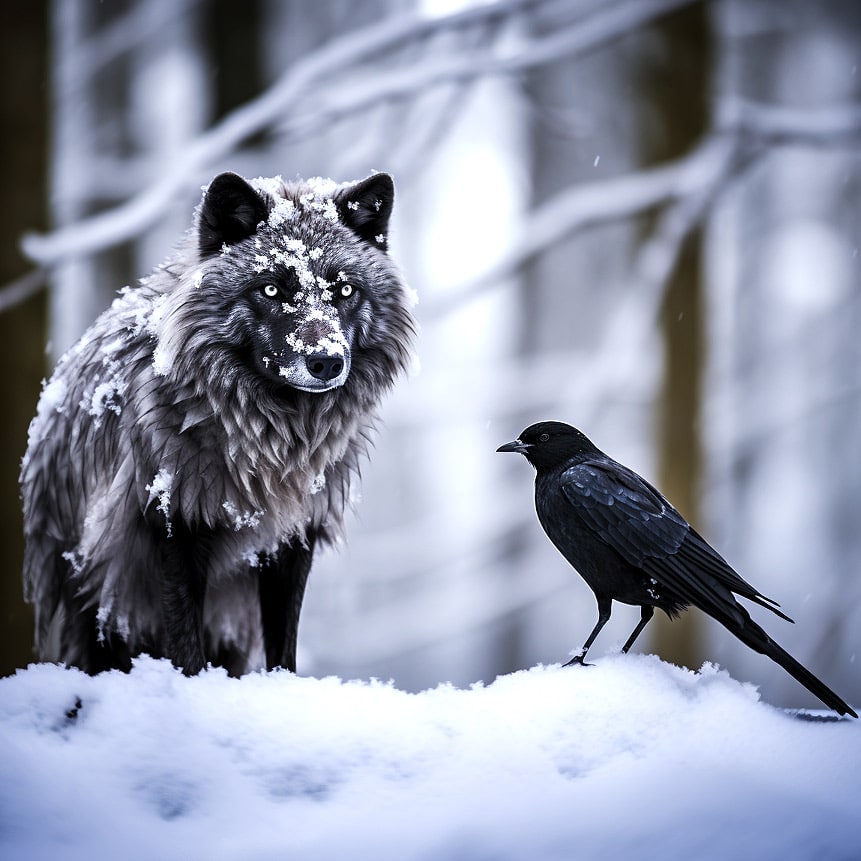
Some researchers believe this bond might come from the shared social nature of both species. Wolves live in packs with complex social hierarchies, where cooperation is key. Ravens, too, are highly social and form tight-knit groups, often communicating with one another through various calls and displays. Both species have evolved to be adaptable and intelligent, which might explain why they’ve figured out how to work together—and even have fun doing it.
This connection is so strong that in areas where wolf populations decline, raven numbers often drop too. It’s as if the ravens are losing their “hunting partners,” and their absence makes survival harder. On the flip side, where wolves are thriving, ravens seem to be doing well too, showing just how interconnected they are.
Next time you’re out in Canada’s forests or open plains and spot a raven flying above or hear its iconic croak, look around—you might just find a wolf nearby. This unlikely friendship between ravens and wolves reminds us that nature is full of surprises, and even the most unexpected creatures can find ways to support each other. It’s a partnership built on instinct, survival, and maybe even a little bit of fun.






 The Blue and White
You must be logged in to post a comment.